
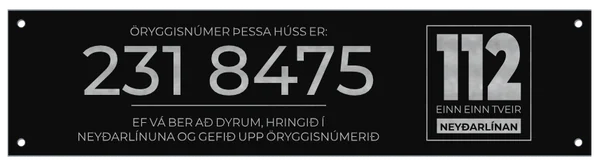

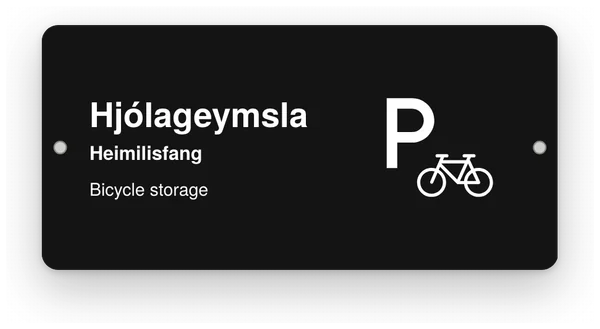








A house number can be seen from the street if it is large enough, contrasts well with the wall and is placed at eye level where light falls on it in the evening. The further the house is from the street, the larger the number needs to be: 10 cm digits close to the street, 15 or 20 cm if the house stands further back.

A good house number is something nobody notices. It is simply there when the courier, the pizza or your guests are looking for the right house. A bad house number, on the other hand, everybody notices, usually in the dark and the rain with a phone in hand.
Here is the advice we would give a friend who is choosing a house number.
What kinds of house numbers are there?
We make house numbers in three ways, and the choice depends mostly on the wall and your taste.
Individual digits. Each digit is cut out separately from 3 mm acrylic and stands on its own on the wall. The digits come with double-sided adhesive on the back, so they are very easy to put up. This is the cleanest look and suits smooth walls, timber and cladding. The digits come in 10, 15 or 20 cm height.
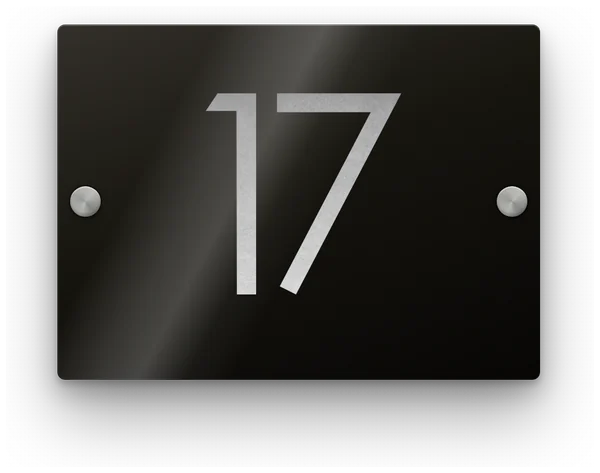
Rectangular house number sign. Here the number is cut out of a plate. The plate comes in 14x14, 19x14 or 29x19 cm and frames the number, which helps on a rough or patterned wall where individual digits would get lost.
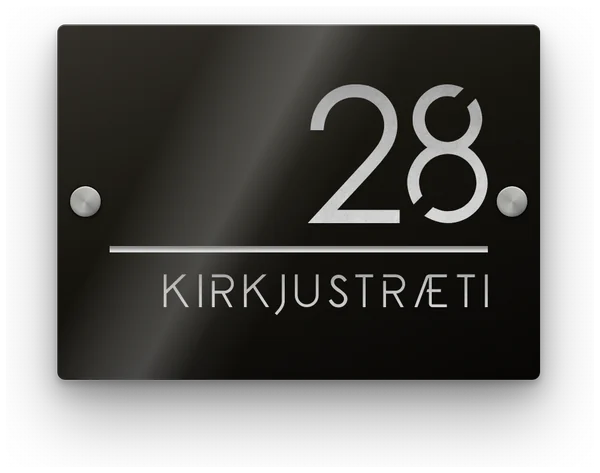
House number and address. The same plate, but with the street name included. That is good on corner houses, in new neighbourhoods and where more than one street leads to the house.
How large should the house number be?
The further the house is from the street, the larger the number needs to be. That is pretty much the whole rule.
- The house stands close to the pavement: 10 cm digits are often enough.
- There are several metres to the street, or people mostly see the house from a car: go for 15 or 20 cm instead.
A simple test: cut a sheet of paper to the size, tape it up and walk out to the street. Can you see it without squinting? Then the size is right.
Which colour is easiest to see on a house number?
Contrast is everything here. A black number on a light wall and a white number on a dark wall are by far the easiest to see. Grey on grey gets lost, no matter how large it is.
There are four colours: white and black, both in gloss or matt. Matt gives a calmer look and reflects the sun less. Gloss is livelier and catches the light.
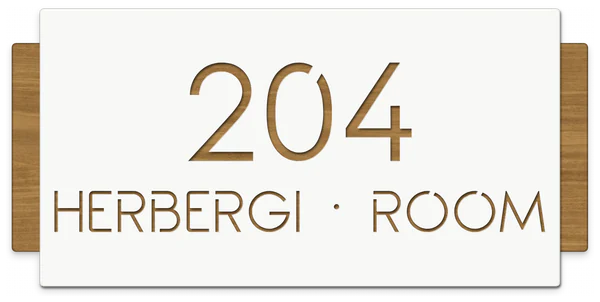
One thing worth knowing about the plates: the number is cut all the way through, so the wall shows through the digits. On a white plate without backlighting the number is seen mainly by the shadow the digits cast. That is why the colour of the wall matters there too.
What font is used on the house numbers?
On the plates the digits are cut in a font designed so that the centre of 0, 6 and 8 stays in place (small bridges). The individual digits come in three styles: Hreint (clean), Mjúkt (soft) and Klassískt (classic).
Letters, for example in 12B, are always capitals. It looks better and reads better.
Should the house numbers have adhesive or standoffs?
The individual digits are always glued. The plates are available with adhesive or with standoffs. Standoffs hold the plate 25 mm from the wall, which gives shadow and depth. They come in silver or black. Adhesive keeps the plate flat against the wall and is the simplest to put up.
Where should the house number go?
Put the number where light falls on it in the evening, preferably near an outdoor light at the entrance. Keep it at eye level or a little higher, and not behind a tree, a bush or a car parked in the driveway.
If the entrance is on the side of the house it sometimes pays to have the number on the street side and another by the door.
Frequently asked questions
Do the house numbers withstand Icelandic weather? Yes. Our acrylic is UV-protected and made for outdoor use in Iceland.
Which size should I choose? 10 cm if the house is close to the street, 15 or 20 cm if it stands further back or is mostly seen from a car.
Can I have a letter too, for example 14A? Yes, and the letter is always a capital.
How long does it take to get the house number? Production takes 3-5 working days and Iceland Post 1-3 working days. Delivery is free, and you can also pick it up from us at Hólmbergsbraut 9a in Reykjanesbær.
Choosing a house number?
If you are not sure about size or colour, feel free to send us a photo of the wall at sm@skiltiogmerkingar.is or through contact us. If you are marking a whole apartment building it is also worth reading the post about signs for shared areas. All the house numbers are on the house number page.